Homeless Man Refused Shelter to Keep His Cat—Then Life Changed Forever
The first time I saw him, he was nothing more than a shadow in the corner outside the all-night laundromat. The pale pink glow from the neon sign flickered over the cracked sidewalk, framing him like a photograph that no one bothered to frame.
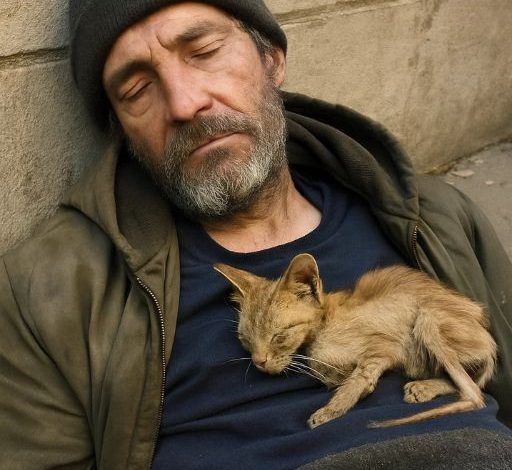
He lay on a worn camping mat that had lost most of its padding years ago. His knees were drawn up, his body angled just so, like he’d found the only position that didn’t ache. On his chest was an orange cat — small, thin, with half an ear missing — sprawled like she owned the place. They breathed in unison, as if they’d practiced for years.
Even asleep, his life was written on him: the duct-taped shoes, the frayed cuffs, the plastic trash bag tied tight and sagging at his side. I didn’t know his name. I didn’t know hers. But I noticed that whenever he stirred, his hand found her fur, and she stayed anchored to him.
I worked the night shift at a nearby café. That’s how I began leaving small offerings — a muffin no one bought, soup in a paper cup, a grilled cheese from a no-show order. He never asked. He never took without saying thanks. And always, the cat ate first.
The Cat Has a Name
One night, I finally sat down on the curb beside him. The air had cooled, but the concrete still held the day’s warmth. The cat opened one amber eye and studied me.
“What’s her name?” I asked.
He looked at her like the answer had been waiting for him to speak it aloud.
“Hazel,” he said, stroking the ragged patch behind her ear. “She chose me. That’s all that matters.”
He told me pieces of his story over time — how family had slipped away after too many unanswered calls, how his mother died alone, how shelters wouldn’t let Hazel in. So he chose the street over a roof.
“She’s my reason,” he murmured one night. “If she’s okay, I’m okay.”
And Then, They Were Gone
One week, the corner was empty. No mat. No bag. No Hazel. For three nights, I looked. The few people who knew him had no answers. Someone said the city had cleared the spot.
Then one icy morning, at the bus stop, I saw her. Hazel. Sitting perfectly still, thinner, duller, but unmistakably her. She didn’t run when I crouched down — she came to me. Her bony frame pressed against my shin like she’d been waiting for this moment.
I carried her home in my arms. She curled into a laundry basket lined with an old sweater and slept so deeply it made my throat ache.
Searching for Martin
I called shelters, hospitals, anyone I could think of, describing him over and over: thin, late forties, scruffy, always with an orange cat missing half an ear. No one had him.
Hazel had a microchip, but the record was old and useless. The vet said she was healthy but underweight. At home, she ignored the toys I bought, but whenever we passed the laundromat, she paused and looked toward the empty corner.
Two weeks later, I got a lead.
A woman named June came into the café with a wet cardboard sign under her arm. She was one of those kind souls who gave out socks and sandwiches to the unhoused.
“You’re the one who used to sit with Martin, right?” she asked.
Martin. His name.
She’d heard he’d collapsed near the train tracks. Someone had taken him to County General. The cat’s description made her certain it was him.
Reunion
The hospital had him. Pneumonia had put him in a coma for nearly two weeks. No ID. No one to call.
I went straight there. Seeing him — pale, shrunken, lost under tubes and wires — was a punch to the chest. I told him Hazel was safe. That she was waiting.
Three days later, his eyes opened.
“Hazel?” he rasped.
The nurse bent the rules. When I carried her in, she bounded onto the bed and tucked herself against him, purring like nothing had happened.
“She found you,” he whispered.
“No,” I said. “She waited.”
A New Start
Recovery was slow, but Hazel kept him company by day, me by night. A charity eventually offered him a small studio in a converted motel — pets allowed. When we opened the door, Hazel trotted in like it was hers all along.
A month later, a woman walked into the café. She was his niece. She’d thought he was gone for good until she saw a photo online of Martin with Hazel in his new place. They reunited quietly — awkward but relieved.
Martin’s life is different now. He volunteers at the shelter that once turned him away. They’ve changed their policy; pets are no longer a reason to refuse someone a bed.
Hazel still sleeps on his chest every night. And I still drop by with muffins.
Because sometimes, the smallest kindness — a leftover sandwich, a warm place to sleep — can ripple through lives in ways you’ll never expect.
All because one cat chose one man.
And that man never stopped choosing her back.
Related Posts


About The Author

John Simmon
Am a Public health specialists,trained professionals who’s focus is on developing conditions where people can be healthy. I work to make my community as healthy as possible.
