He Wore His Sister’s Red Dress to Graduation—Then He Revealed Why
Two weeks before graduation, my son Aaron told me something I never expected to hear.
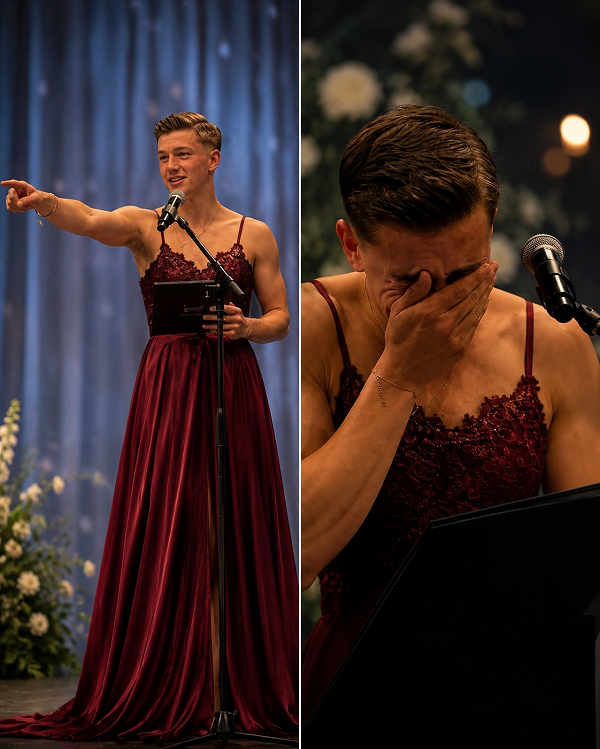
He was going to wear his late twin sister Mary’s red graduation dress.
I begged him to reconsider.
“Mom, I have to,” he said quietly.
He knew exactly what would happen. People would stare. Some would laugh. Others would pull out their phones and record him.
Even his father, Dean, had warned him that he would refuse to attend if Aaron went through with it.
Mary had died only months earlier after a long illness. The red dress was the dress she had chosen for her own graduation.
When Aaron told his father about his plan, Dean exploded.
“Absolutely not.”
“It’s my graduation,” Aaron replied.
“Then dress like someone receiving a diploma.”
Aaron stared at him for a moment.
“Then don’t come.”
Dean didn’t.
Even Aaron’s closest friend stopped speaking to him after seeing the dress.
But Aaron never changed his mind.
On graduation morning, the school asked him to wear something more traditional.
He politely refused.
So I sat in the third row and watched my son walk onto the stage wearing Mary’s bright red dress.
People whispered.
Some laughed.
Several students filmed him.
Aaron kept walking.
He accepted his diploma, stepped down from the stage, and walked straight toward me.
The laughter continued.
Then he stopped beside my seat.
“This is for you,” he whispered.
“For both of you.”
He reached inside the robe and pulled out a tiny package wrapped in a handkerchief.
Inside was a dried yellow daisy.
I recognized it immediately.
Months earlier, Mary had picked that exact kind of flower outside the hospital after we bought the red dress.
“Where did you get this?” I asked.
“Mary gave it to me.”
Then Aaron handed me a folded note.
His hands were shaking.
“She gave it to me three days before she died. She made me promise not to tell you.”
I unfolded the paper.
Mary had written that she knew she probably wouldn’t live long enough to attend graduation.
But she didn’t want Aaron’s graduation to become another painful memory for our family.
She wanted her red dress to be there.
She wanted us to imagine that both of our children were graduating together.
Then I read the final line:
“Mom, please don’t let my empty seat make you forget I was here.”
I couldn’t hold back my tears.
Aaron wrapped his arms around me.
The entire auditorium had gone silent.
The principal then walked over and apologized for asking Aaron to change earlier that morning.
She asked him if he wanted to tell everyone about Mary.
Aaron stood beneath the same lights where people had laughed at him only minutes before.
“My twin sister was supposed to graduate with me today,” he said.
“She chose this dress. She died before she could wear it.”
He held up the little flower.
“She asked me to give this to our mother.”
Then he looked around the auditorium.
“I knew people might laugh. I almost didn’t do it because I was afraid of being ridiculed.”
He paused.
“But Mary was more afraid of being forgotten than I was of being laughed at.”
For a moment, nobody moved.
Then the auditorium erupted in applause.
Later, the student who had filmed Aaron approached him.
So did Ben, his former best friend.
“I’m sorry,” Ben said.
Aaron didn’t answer right away.
Some apologies need time.
As we were leaving, my phone buzzed.
It was Dean.
Someone had sent him the video.
His entire message contained only six words:
“I should have been there.”
I stared at the screen.
I didn’t reply.
That evening, I placed Mary’s dried flower in a frame beside an old photograph of the twins as children.
For months, every picture of Mary had reminded me of what we had lost.
But that night, the picture made me think of something different.
Mary had been here.
She had laughed.
She had loved.
And somehow, on the day her brother graduated, she found a way to be there again.
Not in a chair.
Not beneath the graduation lights.
But in a red dress, a tiny yellow flower, and the heart of a brother who loved her enough to carry her memory with him—no matter who was laughing.
Related Posts
-
 JENNIFER ANISTON: A HOLLYWOOD ICON WHOSE STAR CONTINUES TO SHINE
-
Italian Man And British Woman Fall In Love Using Google Translate After Meeting In A Nightclub
-
My 18th Birthday Surprises for My Stepmom Left Her Completely Shaken
-
I Married a Dying Stranger in a Hospital Hallway So He Wouldn’t Face the End Alone A Week Later, His Attorney Gave Me an Old Green Bag


About The Author

John Simmon
John Simmon is a music journalist and entertainment writer with a passion for country music culture, artist stories, and the moments that happen off the stage. He has been following the country music scene for over a decade, covering everything from chart-breaking newcomers to the legends who shaped the genre. John believes the best stories in country music aren't always found in the music, they're found in the lives behind it.

What a beautiful heart warming story and the courage of a young man for the love of his sister and her memory and also his mother , family. It is a nice start to my day. A nd a big thank you making it so easy to retrieve and read to the end of the story.