My Neighbor Secretly Charged Her Electric Car From My House Every Night. So I Put a Stop to It
My Neighbor Secretly Charged Her Electric Car From My House Every Night. So I Put a Stop to It
I want to tell you exactly what I did before I get to her reaction, because the solution wasn’t dramatic. There was no shouting match, no screaming over the fence, and no scene that could be retold around the neighborhood as proof that I was the “crazy old widow next door.”
I made one quiet, completely legal change.
After that, I simply let Monica’s own habits do the rest.
But to understand why that mattered, you need to know that the charging cable wasn’t where this started.
Monica had been testing my boundaries for years, always beginning with something small enough that objecting made me feel ridiculous.
My name is Constance Whitfield. I’m sixty years old, and I’ve lived in this house for twenty-eight years. I’ve been a widow for six of those years, ever since my husband, Raymond, died suddenly from a stroke.
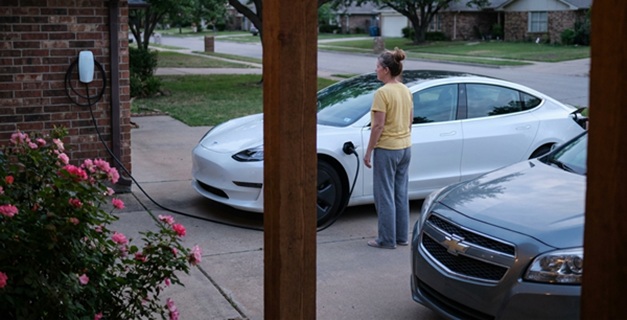
I kept the house because it was ours. Because Raymond planted the roses along the back fence the spring before he died. And because, at the time, moving felt like admitting that I was really alone.
Monica and her family moved in next door about three years ago. There was her husband, Trent, their three children, a golden retriever that seemed to bark at everything that moved, and enough money and energy to completely gut and renovate their kitchen within six months of moving in.
At first, I didn’t dislike her.
She was friendly in that loud, enthusiastic way some people are. She waved constantly. She complimented my roses. She told me about her children’s activities with such enthusiasm that I sometimes felt as though I was supposed to be attending them.
The little boundary violations started during their first year.
One afternoon, I noticed that my garden gnome had moved.
It hadn’t disappeared. It had simply been relocated about six feet to the left and was now sitting in Monica’s yard, right along the edge of our properties.
When I mentioned it over the fence, she laughed.
“Oh, I just thought it looked better over here,” she said. “And honestly, it’s basically on the property line anyway, right?”
It wasn’t.
The gnome was a good four feet onto my property.
But I let it go.
It was a garden gnome, after all.
I told myself there were more important things worth getting upset about.
Then came the lawn mower.
One Saturday morning, I went into the garage and discovered it was gone. I spent nearly an hour looking around before I found it sitting in Monica’s driveway.
The gas tank was empty.
There was no note. No text. She hadn’t asked.
When I confronted her, she looked genuinely surprised that I was bothered.
“Oh, I figured you wouldn’t mind,” she said. “You weren’t using it that day.”
She said it as though ownership of my lawn mower somehow depended on whether I happened to be pushing it across my lawn at that particular moment.
Again, I let it go.
That became the pattern.
One thing.
Then another.
Then another.
I wasn’t oblivious to what was happening. I simply didn’t want to become the difficult neighbor.
I’m sixty years old. I live alone. And there’s a particular exhaustion that comes with knowing that any complaint you make to a younger, louder neighbor can easily be turned around on you.
You can become the fussy widow who complains about everything.
The woman with nothing better to do.
The neighbor who is always looking for a problem.
So I swallowed my irritation.
That was my mistake.
Because then Monica found something considerably more valuable than a garden gnome or a lawn mower.
She found my electricity.
The electric bill arrived on a Tuesday afternoon.
I opened it at the kitchen table and had to read the total twice.
Nearly double what I had been paying every month for the previous two years.
I checked the usual suspects first.
Had I left something running?
Was the refrigerator malfunctioning?
Had I changed the thermostat?
Nothing made sense.
My appliances were the same. My habits were the same. Even the thermostat schedule was the same one I had followed since Raymond died.
I had nothing in the house that could explain such a dramatic increase.
That night, I couldn’t sleep.
My hip had been bothering me, which already made sleeping difficult, and sometime around one in the morning I heard a low electrical hum outside.
It was faint.
The kind of sound you don’t immediately recognize because your brain doesn’t have a category for it.
I got out of bed and went to the window.
From there, I could see the side yard where my garage sat beside the narrow strip of grass separating my property from Monica’s driveway.
And there it was.
Her Tesla.
Parked as close to my driveway as she could get without actually pulling onto it.
A thick black charging cable ran from the car, across the grass, and directly into the outdoor outlet on the side of my garage.
That outlet had been installed years earlier for Raymond’s power tools.
I mostly used it now for my hedge trimmer.
I stood there for several seconds, staring.
Then I went downstairs.
I put on my robe and stepped outside into the cold.
Monica was standing beside her car, looking at her phone.
She seemed completely comfortable.
Completely unconcerned.
As though she were doing nothing more unusual than watering her own lawn.
“Monica,” I said. “What are you doing?”
She looked up.
Then she glanced at the charging cable.
“Oh,” she said. “Charging my car. What’s the big deal?”
I stared at her.
“You’re charging your car from my house.”
She sighed.
It was the sigh of someone who believed she was being extraordinarily patient with a person who was making an unreasonable fuss.
“Oh, come on, Constance. You live alone. How much electricity could you possibly need?”
I said nothing.
She continued.
“Don’t make such a big deal out of it. I have three kids. I’m constantly running errands, taking them places, doing a hundred things. And you’re retired. You just stay home all day.”
There I was, standing outside my own house at one in the morning in a bathrobe, listening to her explain why my electricity mattered less than hers.
Because her life was busier.
Because she had children.
Because I was retired.
Apparently, having a quieter life meant my resources were somehow more available to her.
“You’re using my electricity,” I said. “My bill has doubled.”
She laughed.
“It’s probably only a few dollars, Constance. I don’t know why you’re making such a big deal about this.”
A few dollars.
I didn’t argue with her.
Not that night.
But later that week, once I had worked out how often she had probably been charging and compared it with my utility rate, I realized just how wrong she was.
It wasn’t a few dollars.
It was closer to two hundred dollars a month.
Money coming directly out of the fixed income I had been carefully managing since Raymond died.
Money being used to charge a car that cost more than I had paid for my own vehicle when it was new.
I could have yelled at her.
I could have called her husband.
I could have stood in the street and demanded an apology.
Instead, I smiled.
“Goodnight, Monica.”
Then I went back inside.
And the next morning, I started thinking about something much more useful than an argument.
I started thinking about how to make sure she could never use my electricity again.
Related Posts
-
 Courageous Mother Sacrifices Norms for Children’s Well-being and Faces Unexpected Shock from Future Son-in-Law’s Family
-
 Touching Moments: A Toddler’s Potty Training Journey Moves His Dad to Tears
-
 How Often Should You Wash Your Bra? Expert Bra Care Tips for Longer-Lasting Lingerie
-
 Internet Divided Over Dad’s 45-Minute Gesture to Soothe Daughter to Sleep During Flight
About The Author

John Simmon
John Simmon is a music journalist and entertainment writer with a passion for country music culture, artist stories, and the moments that happen off the stage. He has been following the country music scene for over a decade, covering everything from chart-breaking newcomers to the legends who shaped the genre. John believes the best stories in country music aren't always found in the music, they're found in the lives behind it.
