I Found My Husband’s Secret Home Address After His Funeral What I Discovered Changed Everything
The house felt enormous after Richard died.
Two months had passed, yet I still hadn’t adjusted to the silence. Every morning, I reached automatically for his blue coffee mug—the one with the chipped handle—before remembering that there was no second cup to pour.
I had married Richard when I was twenty-two. I had gone straight from my father’s home to my husband’s, never experiencing the kind of independence most people take for granted.
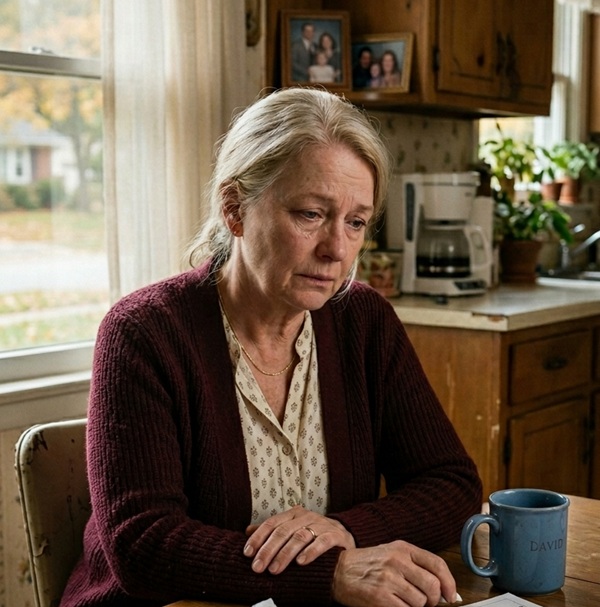
Now, at sixty-two, I was learning how to live alone.
The nights were the hardest. Without Richard, I noticed every sound: the furnace clicking on, the ice maker dropping cubes, the old wood settling in the walls. For the first time in forty years, I understood that if something went wrong during the night, there was no one else to handle it.
But grief itself wasn’t the hardest part.
The hardest part was discovering how much of my life I had never actually learned to manage.
I couldn’t drive.
I couldn’t get myself to the pharmacy.
I depended on my daughter for doctor’s appointments, groceries, errands—everything Richard had always handled.
For forty years, I had accepted that arrangement as normal. Richard had always told me that my reflexes were too slow and that driving wasn’t something I needed to worry about.
When someone you love repeats something about you for decades, eventually you stop hearing it as an opinion.
You start hearing it as the truth.
My daughter became my driver after the funeral. She never complained outright, but I could see how much it was costing her. She had a career, children, and responsibilities of her own.
One afternoon, after picking up my medication, she finally said gently, “Mom, you can’t keep depending on me for every little thing. I love you, but I’m stretched thin.”
I understood.
“Your father always handled all of this,” I told her.
She sighed.
“I don’t understand why Dad never wanted you to be independent. Grandma Eleanor is eighty and does everything herself.”
The mention of Eleanor immediately made me uncomfortable.
My mother-in-law and I hadn’t spoken in nearly forty years.
Richard had always told me she didn’t like me. He said she thought I wasn’t good enough for him, that she had said cruel things about me, and that I was better off keeping my distance.
So I did.
For four decades.
My daughter tried to convince me that perhaps it was time to repair the relationship.
I refused.
“You didn’t hear what she said to me,” I told her. “Your father spent years keeping the peace between us. I’m not going to reopen that.”
She eventually dropped the subject.
That night, however, I sat alone at the kitchen table and stared at the calendar Richard had always maintained.
Every appointment.
Every bill.
Every oil change.
Every doctor’s visit.
Every important date.
All in his handwriting.
I turned the pages backward.
Then backward again.
And something became painfully obvious.
I couldn’t find a single major decision I had made by myself.
Richard had arranged everything.
The money.
The appointments.
The travel.
The driving.
Even the people I saw.
I had always called it being cared for.
That night, I realized it might have been something else.
“I am sixty-two years old,” I whispered to the empty kitchen. “And I’ve never even driven a car.”
The thought frightened me.
But beneath the fear was something I hadn’t felt in years.
Determination.
The next morning, I walked two miles to a driving school.
When the instructor asked whether I had driven before, I told him the truth.
“Never.”
He asked why.
“My husband always said I couldn’t.”
He paused, then smiled.
“Well, let’s find out if he was right.”
For the next several weeks, I practiced secretly.
I didn’t tell my children.
This was the first thing I had ever done entirely for myself, and I didn’t want anyone managing it for me.
I stalled.
I panicked.
I gripped the steering wheel until my hands hurt.
But lesson by lesson, I improved.
Eventually, I stopped being afraid.
My instructor told me I had a natural feel for driving.
“Sometimes people are wrong about us,” he said. “Even people who love us.”
Those words stayed with me.
Then, at sixty-two, I passed my road test on the first attempt.
I cried afterward.
Not because I had passed a test.
Because for the first time in forty years, I could go somewhere without asking anyone.
I had one place I wanted to visit first.
Richard’s grave.
But before that, I wanted to do something else.
I wanted to drive his beloved pickup.
Richard had adored that truck. He washed it every Sunday and never let anyone else drive it.
Now the keys were mine.
I climbed into the driver’s seat and started the engine.
The truck rumbled beneath me.
For the first time, I felt completely in control of where I was going.
I ran my fingers across the dashboard, touching controls I had never been allowed to use.
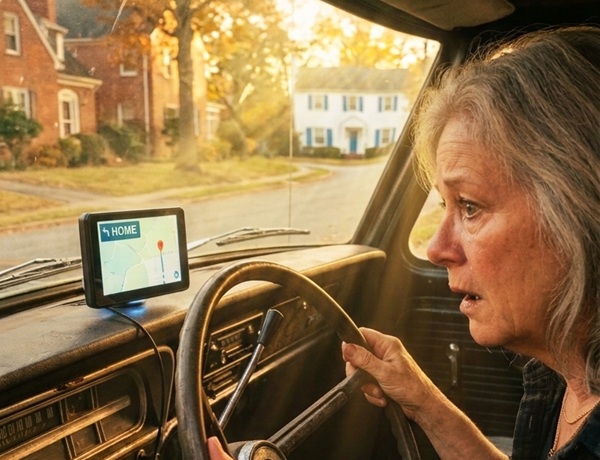
Then I noticed the navigation system.
There was a little house icon labeled Home.
I pressed it.
I expected to see our address.
Instead, an unfamiliar address appeared.
A house in another town, about twenty minutes away.
I stared at the screen.
“That isn’t our house.”
I pressed it again.
Same address.
Same destination.
Same label.
Home.
My hands went cold.
Richard had another home.
Immediately, every unexplained absence of the past forty years came rushing back.
The long errands.
The fishing trips.
The afternoons he had spent away.
The times he returned smelling like coffee I hadn’t made.
I thought of another woman.
Another family.
Another life.
My heart was pounding, but I didn’t turn around.
For most of my life, I had been the passenger.
I wasn’t going to be one anymore.
I put the truck in gear and followed the navigation.
The streets gradually became unfamiliar.
Eventually, I entered a quiet neighborhood filled with old brick houses, mature trees, and carefully maintained gardens.
Then the navigation announced:
“You have arrived at your destination.”
I looked to my left.
And froze.
Blue shutters.
Rose bushes.
A porch swing.
I knew that house.
It belonged to Eleanor.
My mother-in-law.
The woman Richard had spent forty years convincing me hated me.
I sat there trying to understand.
Why would Richard’s truck have her address saved as Home?
Why had he been coming here?
Why had he kept us apart for nearly four decades?
Part of me wanted to drive away.
But I had spent forty years accepting other people’s answers.
I wasn’t going to do that anymore.
I climbed out of the truck and walked up the steps.
Then I rang the bell.
The door opened.
Eleanor stood there.
She was older, smaller, and completely white-haired now, but I recognized her immediately.
Her eyes moved from me to the truck.
“You drove here,” she said.
“Yes.”
“Yourself?”
“Yes.”
I told her I had finally learned.
She looked at me with an expression I couldn’t understand.
Then her face crumpled.
“Then he never told you.”
“Told me what?”
She stepped aside.
“You’d better come in.”
Inside, the house smelled like lavender and old books.
Then I noticed the photographs.
My children.
As babies.
My grandchildren.
Years of photographs I had never seen.
Eleanor had kept them all.
She brought out two cups of tea—the good cups with gold rims—and sat across from me.
I couldn’t wait any longer.
“Richard told me you hated me.”
Eleanor stared at me.
“He told me you wanted nothing to do with me,” she replied.
We looked at each other.
Then the truth became obvious.
We had both been lied to.
For forty years.
The same man had told each of us that the other wanted nothing to do with us.
But why?
Eleanor asked whether I remembered painting when I was young.
Watercolors.
Harbors.
Boats.
I had almost forgotten.
After marrying Richard, I had stopped painting because he told me it was childish and that I needed to focus on being a wife and mother.
Eleanor’s expression changed.
“They weren’t childish,” she said. “They were good.”
Then she told me something that made the room seem to tilt.
A gallery owner had seen one of my paintings at a church fair.
He wanted to represent me.
He had offered me a place in a group exhibition and even offered to teach me.
It had been a genuine opportunity.
I had never heard about it.
Not once.
Eleanor had sent the information through Richard.
He never gave it to me.
Instead, he told Eleanor that I wasn’t interested.
Then he told me that Eleanor had never supported me.
She had tried to reach out.
He intercepted her letters.
She called.
He answered.
He told her I didn’t want to speak to her.
He told me she didn’t want me in her life.
He kept us separated because, if we ever sat down together, we would discover the truth.
And now we had.
I looked at Eleanor.
“Why would he do that?”
She was silent for a moment.
Then she said something that explained everything.
“That is why he never wanted you to drive.”
I stared at her.
“He knew that if you could drive, you could go wherever you wanted. You could come here. You could find out what I had been trying to tell you. You could become independent.”
The realization hit me harder than anything else.
The driving hadn’t been an isolated piece of controlling behavior.
It had been the key.
If Richard controlled the keys, he controlled where I went.
If he controlled where I went, he could control who I saw.
And if he controlled who I saw, he could control what I knew.
Forty years of my life suddenly looked different.
The isolation.
The abandoned paintings.
The dependence.
The belief that I wasn’t capable.
It had all been connected.
Then Eleanor showed me something she had kept for decades.
A file box.
Inside were letters.
Copies of messages.
Photographs.
Documents.
And finally, a letter from the gallery owner.
Richard had answered it himself.
He had declined the offer on my behalf.
He had written that I wasn’t interested.
He had signed it.
He had made the decision for me without ever telling me the opportunity existed.
I stared at his handwriting.
“He answered for me for forty years,” I whispered.
“This is just the first time he wrote it down.”
Eleanor nodded.
Then she told me that Richard had started visiting her again near the end of his life.
He would sit in her living room for hours.
He had apparently intended to tell the truth.
But he died before he could.
That was why her address had been saved in his truck.
He had been trying, perhaps too late, to undo what he had done.
I didn’t know what hurt more—that he had lied for so long, or that he had finally decided to tell the truth only when there was almost no time left.
I was afraid my children wouldn’t believe me.
They loved their father.
To them, he had been kind, dependable, protective.
So I brought Eleanor home with me.
I called my children together.
My daughter immediately assumed I had finally decided to reconnect with her grandmother.
“Not exactly,” I told her.
“Eleanor found me.”
Then we told them everything.
At first, my son became angry.
“Dad isn’t here to defend himself,” he said.
My daughter insisted that their father had only been overprotective.
Then Eleanor placed the old letter on the table.
My daughter picked it up.
Her eyes moved across the page.
Then she froze.
“This is Dad’s handwriting.”
My son leaned over to read it.
The room went silent.
He had signed my name.
He had declined the opportunity for me.
He had made a decision about my entire future without allowing me to know there was ever a choice.
My daughter began to cry.
“Mom, I’m sorry.”
I hugged her.
“You were children. You believed your father. I believed him too.”
I didn’t want them to hate Richard.
He had been their father.
He had loved them.
That part could be true while everything else was also true.
“I don’t need you to hate him,” I told them. “I just need you to see me. The real me.”
Not the helpless woman Richard had described.
Not the woman who supposedly didn’t want anything.
The woman who could drive.
The woman who had once painted.
The woman who could still decide where her life went from here.
The truth was painful, but it was finally ours.
For the first time, Eleanor and I were sitting together as family instead of enemies.
The years we had lost could never be recovered.
But the years ahead belonged to us.
A few days later, I drove myself to Richard’s grave.
I brought flowers.
I parked the truck myself.
I walked to his grave alone.
I had imagined that I would be furious.
Instead, I felt strangely calm.
I placed the flowers beside his stone.
“You were wrong about me,” I said quietly.
“About all of it.”
I told him I wished he had found the courage to tell the truth sooner.
Then I said the thing that mattered most.
“I would have listened.”
I stood there for another moment.
Then I returned to the truck.
And I drove home.
The long way.
Not because I needed to.
Because I could.
And I have started painting again.
I bought inexpensive watercolors and paper and sat down at my kitchen table.
At first, my hands felt unfamiliar holding the brush.
But they remembered.
The paintings aren’t perfect.
Forty years is a long time to be away from something.
But they are getting better.
And they belong to me.
Eleanor comes over on Thursdays now.
Sometimes we sit together and talk.
Sometimes we drive to the harbor so I can paint.
Sometimes we simply sit in comfortable silence, making up for four decades when we were kept apart.
I spent most of my life believing freedom meant having someone take care of you.
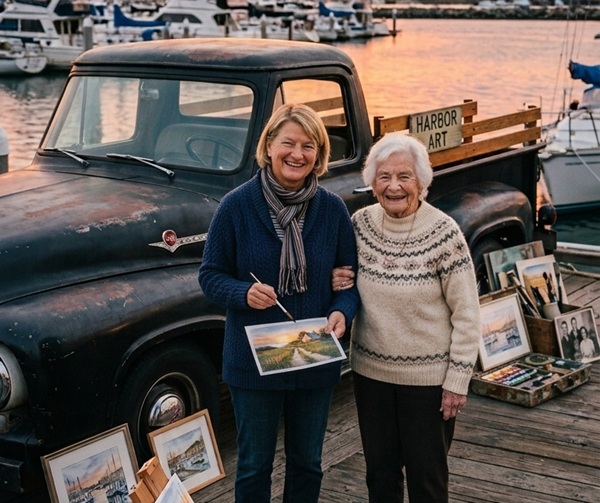
Now I understand that real freedom is being able to choose for yourself.
Where you go.
Who you see.
What you create.
What you believe.
And where you want to go next.
For the first time in my entire life, nobody else has the keys.
And I’m finally learning how to use them.
Related Posts


About The Author

John Simmon
John Simmon is a music journalist and entertainment writer with a passion for country music culture, artist stories, and the moments that happen off the stage. He has been following the country music scene for over a decade, covering everything from chart-breaking newcomers to the legends who shaped the genre. John believes the best stories in country music aren't always found in the music, they're found in the lives behind it.
