Five siblings were about to be sent to three different homes then a 29-year-old single man stepped forward.
What I Told the Judge
There are things I said in that courtroom.
And then there are the things I didn’t say.
The words I eventually gave Judge Miller were honest, but they were only the part of the truth I knew how to explain out loud.
The rest had been sitting inside my head for nearly three weeks.
By the time the state’s attorney finished speaking, the courtroom had become so quiet that I could hear the faint movement of papers on the judge’s desk.
Judge Miller leaned forward.
He looked directly at me.
It wasn’t an angry look.
It wasn’t even suspicious.
It was the expression of someone who had spent decades listening to people explain why they wanted something—and had learned how to recognize the difference between genuine conviction and a performance.
My name is Carter.
I was twenty-nine years old.
I was single.
I lived in a modest three-bedroom house in Ohio, a house I had been paying a mortgage on for two years.
I worked as a licensed electrician.
It was a good trade.
It paid enough to keep the bills covered, and because I could control much of my schedule, I had always considered that flexibility one of the biggest advantages of my job.
I wasn’t rich.
I didn’t have investments worth millions.
I didn’t own some enormous house with ten bedrooms and a swimming pool.
I was just a guy who worked hard, paid his bills, and had been slowly trying to build a better future for himself.
Before everything changed, I had about twenty-two thousand dollars in savings.
I’d spent four years putting that money away.
The plan was simple.
Eventually, I wanted to buy a larger property.
Maybe somewhere outside the city.
Maybe somewhere with enough land that I could have a workshop and some space around the house.
It wasn’t an extravagant dream.
But it was mine.
Then I saw a photograph.
And suddenly, my plans didn’t seem nearly as important.
The photograph had been posted on our county’s emergency placement registry.
When children need somewhere to go quickly, the system sometimes publishes photographs because there isn’t time to follow the normal matching process.
I remember opening the page that evening.
I remember scrolling.
And then I stopped.
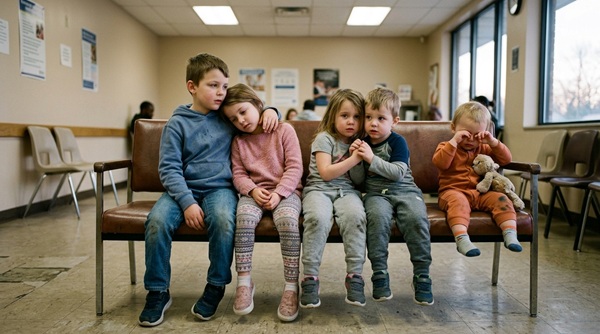
There were five children sitting together on a plastic bench.
Five.
The oldest looked around seven years old.
The youngest was barely eighteen months.
They were sitting close enough that their shoulders touched.
But what struck me wasn’t their ages.
It was the way they were holding onto one another.
The oldest boy had his arm around a little girl beside him.
She was holding onto another child.
That child was keeping the toddler close.
And the youngest was pressed against the others as if the entire group had instinctively decided that the safest place in the world was together.
They weren’t posing for the camera.
They weren’t smiling.
They weren’t trying to look brave.
They were simply holding on.
I saved the photograph.
Then I closed the page.
I went back to making dinner.
I ate alone at my kitchen table.
I watched television.
I went to bed.
The next morning, I went to work.
But that photograph stayed in my mind.
Not like a normal memory.
It felt more like a question.
One I couldn’t get rid of.
I tried to ignore it.
I couldn’t.
By the following evening, I had looked up the case.
I learned their names.
Marcus was seven.
Amara was five.
Joel was four.
Destiny was two.
And the youngest was eighteen months old.
Her name was listed inconsistently, and I wouldn’t learn what she actually called herself until later.
At that point, all I knew was that there were five children who had suddenly lost the only family structure they knew.
Their mother had died unexpectedly.
She was only thirty-two.
She had suffered a stroke in the apartment where she lived with her children.
Marcus, the oldest, had been the one who called emergency services.
Paramedics came.
The ambulance came.
Then social workers came.
By the end of the day, the five children were in temporary care.
Their father wasn’t involved.
There were no relatives who could take all five together.
One aunt was willing to take Marcus.
Another family friend had expressed interest in the youngest child.
But the other three had nowhere to go.
The agency had found three separate homes.
Three different counties.
Three different placements.
The plan was to move the children apart.
I couldn’t stop thinking about the photograph.
I called the social worker.
Her name was Debra.
She wasn’t cold.
She wasn’t dismissive.
In fact, she sounded like someone who had spent years working inside a system where good intentions didn’t always create good options.
“You understand this isn’t simple,” she told me.
“Yes.”
“You’re one person, Carter.”
“I know.”
“There are five children. They’re all under seven.”
“I know.”
She paused.
Then she said, “We’re not separating them because we want to. We’re separating them because we haven’t found anyone who can take all five.”
That sentence stayed with me.
“What if you did find someone?” I asked.
There was silence on the other end.
“Someone who could genuinely commit to all five,” she said slowly, “who has suitable housing, a stable income, and passes all the required checks would absolutely be considered.”
I looked around my kitchen.
Then I asked the question that would change everything.
“How long do I have?”
“The placement order is scheduled for Thursday.”
I looked at the calendar.
Nine days.
Nine days.
I hung up.
For the next several hours, I did something that probably looked completely irrational from the outside.
I did math.
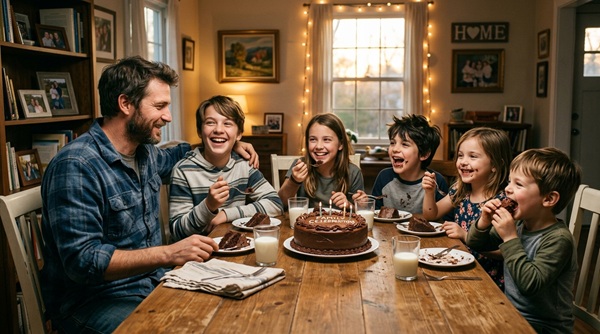
Actual math.
I wrote down my income.
My mortgage.
Utilities.
Insurance.
Food.
Transportation.
Then I estimated what five young children would cost.
Childcare.
Clothing.
School supplies.
Medical expenses.
Food.
Everything.
The first calculation didn’t work.
Not comfortably.
Not even close.
But instead of deciding that meant I couldn’t do it, I started looking for what could change.
My work schedule was flexible.
I could take more electrical jobs.
I could reduce my workload initially and increase it later.
I had a detached workshop behind the house.
I’d barely been using it.
It could be converted.
Five children needed beds.
The workshop had space.
I could build bunk beds.
The savings?
The savings had been for land.
Land could wait.
The children couldn’t.
I called my sister.
Her name is Dana.
She’s three years older than me, has two children of her own, and has known me my entire life.
She’s also the person who tells me when I’m being stupid.
I explained everything.
She didn’t interrupt.
When I finished, she asked:
“Are you calling to ask if this is a sane decision?”
“Yes.”
She took a breath.
“No.”
I laughed nervously.
“No?”
“No. It isn’t sane.”
I was quiet.
Then she added:
“But sane and wrong aren’t always the same thing.”
I leaned back in my chair.
“That’s what I was thinking.”
She didn’t answer immediately.
Then she said something I’ll never forget.
“Carter, those children are going to be separated unless somebody changes the situation.”
“I know.”
“You’re not their only possible family in the world.”
“I know.”
“But right now, you’re the only person who is actually standing there saying, ‘I’ll take all five.’”
I looked down at the floor.
“Yeah.”
She paused.
“Do you understand what you’re volunteering for?”
“No,” I admitted.
Then I said:
“But I know what I’m volunteering against.”
She waited.
“I’m not going to sit here and watch five siblings get put into different cars because nobody was willing to make room.”
Dana was quiet for a long time.
Then she said:
“I’ll help you.”
I didn’t ask how.
She didn’t know either.
But she meant it.
The next morning, I went to the hardware store.
I bought lumber.
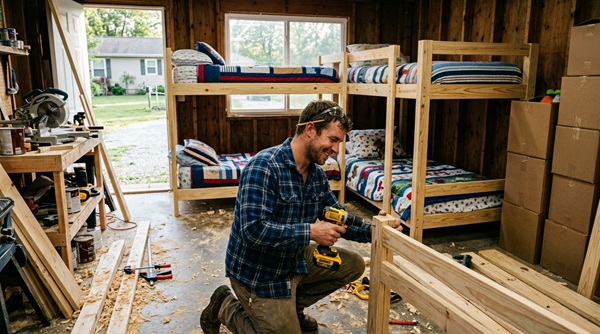
Then I went home and started converting the workshop.
I built bunk beds.
I’d never built bunk beds before.
I studied plans.
I measured everything twice.
Then I measured it again.
I wanted those beds to be solid.
Not temporary.
Not something thrown together because I was in a hurry.
I wanted the children to walk into that room and know that someone had prepared a place specifically for them.
I bought five car seats.
I bought bedding.
I bought clothes.
I bought towels.
I bought storage bins.
I bought books and toys.
I didn’t know what they liked, so I tried to make the room feel like a place where they could eventually discover what they liked.
Then I hired a family attorney.
Her name was Rachel Chen.
She had a reputation for taking difficult family cases seriously.
When I told her what I wanted to do, she didn’t congratulate me.
She asked questions.
A lot of them.
Where would the children sleep?
How would I pay for childcare?
What would happen if I couldn’t work?
Who would help me?
What was my criminal history?
What was my medical history?
What did I know about trauma?
What did I understand about adoption?
I answered everything honestly.
Then I paid her.
Almost all the money came from the savings account.
The money I’d spent four years building disappeared in a matter of days.
I watched the balance fall.
And strangely, I didn’t feel like I’d lost anything.
I felt like I had finally figured out what the money was for.
On the eighth day, Debra called.
The agency had decided to support my application.
That didn’t mean the children were mine.
It meant they were willing to recommend that the court consider me.
There was still a home study.
It had to happen immediately.
The assessor arrived the next day.
Her name was Gloria.
She walked through my house with a clipboard.
She inspected everything.
The kitchen.
The bathrooms.
The bedrooms.
The yard.
Then she walked into the converted workshop.
She stopped when she saw the bunk beds.
“You built these?”
“Yes.”
“When?”
“Last week.”
She looked at them again.
Then she wrote something down.
She asked about childcare.
I explained my plan.
For the first several months, I would reduce my electrical work.
I’d already spoken with two childcare providers.
One offered a sliding-scale rate.
My sister had agreed to help with afternoon pickups.
I had calculated how long I could survive on reduced income.
“Approximately four months,” I told her.
“And after that?”
“I’ll increase my workload.”
She looked at me.
“You’re confident you can do that?”
“Yes.”
Then came the questions I had been expecting.
“What do you know about raising five children under seven?”
I almost laughed.
“Very little.”
She looked up from her clipboard.
I continued.
“I know what I know. And I know what I don’t know.”
“What don’t you know?”
I thought carefully.
“I don’t know what it’s like to have a child wake up at three in the morning screaming because they’re dreaming about their mother.”
I paused.
“I don’t know what it’s like to have five children do that.”
She waited.
“I don’t know what Marcus will need.”
I looked at the bunk beds.
“I don’t know what Amara will need. Or Joel. Or Destiny. Or the baby.”
Then I looked back at her.
“But I know what happens if nobody steps forward.”
She didn’t say anything.
I continued.
“They get separated.”
I swallowed.
“And Marcus is seven.”
Gloria looked at me.
“He called 911 when his mother collapsed. He’s been trying to keep those children together ever since.”
I took a breath.
“I can’t undo what happened to them. But I can give him a place where he doesn’t have to be the adult anymore.”
She wrote something down.
Then she said:
“You have stable employment. No criminal history. No child protective services history. Suitable housing.”
She looked around the room.
“The recommendation will be positive, subject to the judge.”
She left.
The next morning, Debra called.
The home study was supportive.
The hearing was set for one o’clock.
I had forty-eight hours.
Those two days were strange.
I kept asking myself why I was doing this.
Rachel told me Judge Miller would ask.
She said I shouldn’t prepare a speech.
I should tell the truth.
Because experienced judges could recognize a rehearsed answer.
So I tried to figure out what the truth actually was.
There wasn’t one simple reason.
I had grown up without my father.
He left when I was three.
My mother worked two jobs.
My sister Dana was four years older than me.
And when you’re a child in that kind of situation, you notice things.
You notice when your older sibling becomes more responsible than they should be.
You notice when she makes sure you eat.
You notice when she tries to calm you down.
You notice when she becomes the person who holds everything together.
Dana had been a child too.
But sometimes she had been forced to act like an adult.
I knew what that did to a kid.
And Marcus was seven.
Seven.
He had called emergency services when his mother collapsed.
He had watched adults arrive.
He had been moved from place to place.
And for three weeks, he had been trying to make sure his brothers and sisters were okay.
I didn’t know everything about him.
But I knew enough.
I knew I didn’t want him carrying that responsibility anymore.
Then the hearing came.
I sat in the courtroom.
The children were behind me.
Marcus sat beside Amara.
Joel was next to them.
Debra was holding Destiny.
The youngest child was beside her.
I looked at Marcus.
He was sitting perfectly straight.
He looked like a little boy trying very hard to behave like a grown man.
The state’s attorney spoke first.
He described me as inexperienced.
Young.
Unrealistic.
He said I had good intentions.
But good intentions weren’t enough.
He warned the judge that five traumatized children could overwhelm someone who had never raised a child.
And I couldn’t argue with all of it.
I was scared too.
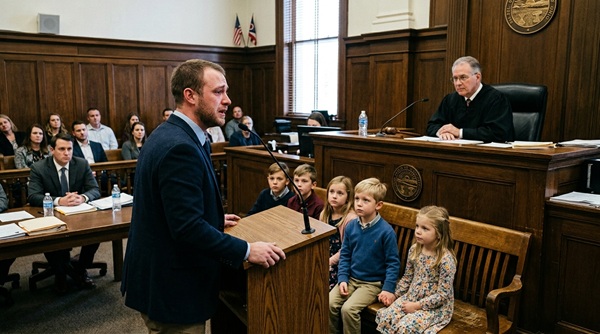
Then Judge Miller looked at me.
“Mr. Carter.”
“Yes, sir.”
“Why?”
One word.
Why would a twenty-nine-year-old single man take responsibility for five children who weren’t related to him?
Why would he give up his savings?
Why would he change his house?
Why would he sacrifice his freedom?
Why would he risk his career?
The courtroom went completely silent.
I looked behind me.
Marcus was holding Amara’s hand.
And suddenly, I didn’t need a prepared answer.
I told the judge about the photograph.
I told him about sitting alone in my kitchen.
I told him about the phone call with Debra.
I told him about the bunk beds.
The car seats.
The savings.
I told him the state’s attorney was right about one thing.
I didn’t know exactly what I was getting into.
Then I talked about Marcus.
I said:
“That boy is seven years old.”
My voice shook.
“He called 911 when his mother collapsed.”
I paused.
“And he’s been trying to keep his siblings together ever since.”
I looked at Judge Miller.
“I know what that does to a child because I’ve seen it happen in my own family.”
I told him about Dana.
Then I said the sentence that had been in my head from the beginning:
“I can’t fix what happened to these children.”
I took a breath.
“But I can give them a home where Marcus doesn’t have to hold everyone together alone.”
Nobody moved.
I continued.
“I’m not saying I’ll do this perfectly.”
I looked down for a moment.
“I won’t.”
Then I looked back at him.
“But I can do it.”
I said that the alternative was three different counties.
Three different homes.
Five siblings losing the last family connection they had.
And I couldn’t accept that if I had the ability to stop it.
Judge Miller was silent.
He looked at the paperwork.
Then at me.
Then at the children.
He waited.
Thirty seconds can feel like an eternity in a courtroom.
Then he spoke.
“Mr. Carter, I have one more question.”
“Yes, sir.”
“Do you understand what you’re agreeing to?”
“Yes.”
“If this adoption is finalized, you will be legally and financially responsible for these children.”
“Yes.”
“There is no easy exit.”
“I understand.”
“You will be their parent.”
I looked at Marcus.
Then at Amara.
Joel.
Destiny.
The youngest.
“Yes,” I said.
The judge looked at me for another moment.
Then he looked at the children.
He had been a judge for more than thirty years.
When he finally spoke, his voice was different.
Less formal.
More human.
“I’ve seen a lot of people come through this courtroom,” he said.
He paused.
“People with good intentions. People with complicated motives. People who believe they know what they’re doing.”
Then he looked directly at me.
“You don’t know everything you’re getting into.”
I nodded.
“No, sir.”
“But you appear to understand something important.”
He looked at the children.
“These children need each other.”
Then he signed the order.
The placement was approved.
The children would stay together.
All five.
Rachel touched my arm.
Behind me, Debra was explaining what had happened to the children.
Then I heard Marcus ask quietly:
“We’re all going?”
Debra answered:
“You’re all going.”
There was a pause.
Then I heard a sound from behind me.
A small, broken sound.
The kind a child makes when they’ve been trying not to cry for too long.
That sound stayed with me.
That afternoon, all six of us drove home.
I had practiced the car-seat arrangement in the parking lot the day before.
Five children require logistics.
A lot of logistics.
The drive was loud.
Destiny cried.
Joel provided a running commentary about everything outside the window.
Every truck.
Every sign.
Every building.
Every bird.
Marcus said almost nothing.
He sat quietly in the back.
When we reached my driveway, I got out.
One by one, I opened the doors.
Marcus was the last to leave the truck.
He stood in the driveway.
He looked at my house.
“This is it?” he asked.
“This is it.”
He stared at the house.
Then he looked at me.
“Can I see the bedroom?”
“Of course.”
We walked inside.
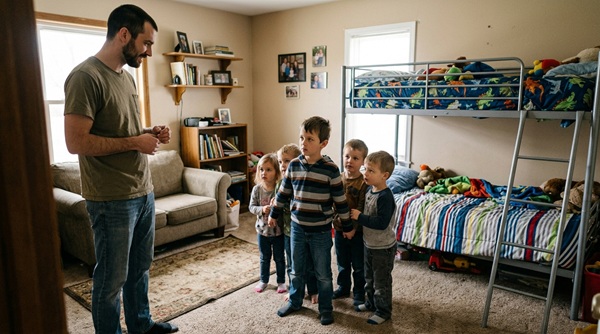
He stepped into the converted workshop.
He looked at the bunk beds.
Five different blankets.
Storage spaces.
Books.
Toys.
Clothes.
Everything had a place.
He walked slowly around the room.
Then he stopped.
“You built these.”
“Yes.”
He touched the edge of one bunk.
“They’re good.”
“Thanks.”
He looked at me.
There was something in his expression that I couldn’t quite understand.
Then he said:
“You don’t have to do this.”
I wasn’t expecting that.
“What?”
“You don’t have to do this.”
He repeated it.
“We’re not yours.”
I sat on the bottom bunk.
He stayed standing.
I wanted to make sure I was looking at him at eye level.
“No,” I said.
“You’re right.”
“I don’t have to.”
He looked at me.
“But I’m going to.”
He didn’t say anything.
“Because you need someone to,” I continued, “and I can.”
He stared at the floor.
“Is it because we’re getting separated?”
“That was part of it.”
He looked up.
“What’s the other part?”
That question was harder.
I thought about it.
Then I told him.
“Because you’ve been taking care of everybody for three weeks.”
He didn’t move.
“And you’re seven.”
His eyes dropped.
“You shouldn’t have to do that.”
He was quiet.
Then he said:
“I’m tired.”
“I know.”
“Not sleepy.”
I nodded.
“I know.”
“I’m just tired.”
I sat beside him.
“Then you can be tired.”
He looked at me.
“You don’t have to fix everything.”
He didn’t answer.
Then he said:
“Okay.”
That was the beginning.
The first night was chaotic.
I had imagined some sort of peaceful transition.
That was ridiculous.
At two in the morning, Destiny woke up crying.
She woke Nina.
Nina woke Joel.
Joel woke Amara.
Within half an hour, all five children were awake.
I ended up sitting with them in the living room while cartoons played quietly on the television.
It wasn’t responsible bedtime.
It wasn’t part of the plan.
But sometimes the plan has to wait.
Marcus eventually came into the room.
He looked at the other children.
“I usually handle this,” he said.
I looked at him.
“Not anymore.”
He stared at me.
Then he sat down.
And he watched the cartoons.
That was the first night.
It wasn’t perfect.
But it was ours.
The weeks that followed taught me things no preparation could have taught me.
Joel needed warnings before transitions.
If you told him something was happening five minutes from now, he needed to know again at three minutes.
And again at one minute.
Amara processed things through drawing.
Paper and colored pencils became essential supplies in our house.
Destiny tested every boundary she could find.
Not because she was bad.
Because she needed to know whether the boundaries would stay where they were supposed to.
Nina wanted physical closeness.
If I sat still long enough, she’d climb into my lap and fall asleep.
And then there was Marcus.
Marcus needed something different.
He needed permission to be seven.
He had learned that the oldest child was supposed to solve problems.
If Destiny cried, Marcus moved.
If Joel needed help, Marcus moved.
If Nina made a noise, Marcus was halfway across the room before I could react.
He had learned to manage everyone.
So I began telling him something over and over.
“You can help.”
“But you don’t have to manage them.”
“They’re my responsibility.”
“You’re allowed to play.”
“You’re allowed to be upset.”
“You’re allowed to make mistakes.”
“You’re allowed to be seven.”
It took months.
Patterns don’t disappear because someone explains them once.
But slowly, Marcus began to change.
He started playing more.
He stopped automatically getting out of bed every time one of the younger children made a noise.
He started asking me for help.
That was progress.
My sister Dana kept her promise.
Every Saturday, she came over.
Sometimes she cooked.
Sometimes she read books.
Sometimes she took one of the children outside.
Sometimes she simply sat at the table and talked.
One Saturday, she sat with Marcus in the backyard for nearly an hour.
They didn’t talk about trauma.
They didn’t talk about his mother.
They talked about baseball.
That mattered.
Children need adults who have time for ordinary conversations.
About six weeks after the children came to live with me, I called Dana late at night.
All five were finally asleep.
The house was quiet.
“How are you?” she asked.
“Tired.”
“But?”
I smiled.
“Good tired.”
She laughed.
“The kind of tired you get when you know something matters.”
“Exactly.”
She paused.
“Carter.”
“Yeah?”
“You’re doing something real.”
I looked down the hallway.
“I know.”
“Just don’t forget to sleep.”
“I’ll try.”
She laughed.
“Welcome to parenthood.”
The agency continued its regular visits.
Every two weeks, Debra or another caseworker came to the house.
They spoke with the children.
They spoke with me.
They checked the rooms.
They asked about school.
They asked about behavior.
They asked about finances.
They asked about how everyone was adjusting.
The reports kept coming back positive.
That surprised me.
Not because things were terrible.
They weren’t.
But because I expected the professionals to see the risks.
And they did.
They just also saw the progress.
One afternoon, Debra stood in the kitchen after a visit.
“You’re doing well,” she said.
I thanked her.
Then she added:
“You know what makes the biggest difference?”
“What?”
“You knew from the beginning what you didn’t know.”
I didn’t understand.
She explained.
“Most people come into emergency placements thinking they can save everybody because they’re good people.”
She shook her head.
“You didn’t do that.”
“What did I do?”
“You looked at the situation and said, ‘I don’t know how to do this yet, but I’m willing to learn.’”
That stayed with me.
Six months after the first hearing, we returned to court.
This time, it was different.
This was the adoption finalization.
The children were dressed for the occasion.
Amara had chosen her own outfit.
It didn’t match.
At all.
But she loved it.
Joel wore what he considered his best shirt.
Marcus wore jeans and a gray sweatshirt.
Destiny had discovered headbands.
She was wearing four.
Nina wore pink boots.
She insisted on them.
Judge Miller was there.
He didn’t have to be.
Another judge could have handled the finalization.
But he came anyway.
When the five children entered the courtroom, he looked at them for a long time.
Then he smiled.
“Let’s make this official.”
We signed the papers.
One by one.
The family became permanent.
Afterward, Judge Miller came around from behind the bench.
He knelt down so he could speak to the children at their level.
He talked to them quietly.
I couldn’t hear every word.
Amara showed him an origami bird.
Destiny pointed at his robe and said something that made him laugh.
Marcus stood beside him, answering questions with the seriousness he always used when speaking to adults.
Then Judge Miller stood.
He looked at me.
“Well done, Mr. Carter.”
I almost laughed.
I hadn’t done anything that morning except sign paperwork.
But I knew what he meant.
The work had happened during the six months before.
We drove home.
Marcus was quiet again.
The younger children were doing what they always did.
Joel talked.
Amara narrated a story.
Destiny pointed at things.
Nina wanted the window lowered.
We pulled into the driveway.
Marcus didn’t immediately get out.
“Carter?”
“Yeah?”
“Is this permanent now?”
I looked at him.
“Yes.”
He looked toward the house.
“This is permanent.”
He nodded.
“Okay.”
Then he opened the door.
He went inside.
I stayed in the driver’s seat for a moment.
I thought about the day I had seen the photograph.
The plastic bench.
Five children holding onto one another.
The money in my savings account.
The workshop.
The bunk beds.
The courtroom.
Everything.
Then I got out.
I went inside.
Nina was waiting by the door.
She had her pink boots on.
She looked up at me.
I picked her up.
She said something in the language she was still developing.
I didn’t understand every word.
But I understood enough.
We went inside.
And that could have been the end of the story.
Except it wasn’t.
Because adoption papers don’t magically solve everything.
The courtroom is one day.
Parenthood is every day after that.
The first year brought hundreds of small moments that mattered just as much as the hearing.
The first was Marcus’s birthday.
He turned eight.
I asked him what he wanted.
He said:
“Nothing.”
I’d learned by then that “nothing” sometimes meant something else.
I asked again.
“What do you want?”
He thought about it.
For several days.
Then he finally told me.
“I want a birthday that’s mine.”
I didn’t understand immediately.
He explained.
He didn’t want a party where everyone celebrated.
He wanted one day that was specifically about him.
Just him.
So I arranged it.
The younger kids stayed with Dana.
Marcus and I went bowling.
It wasn’t fancy.
It wasn’t expensive.
But it was his.
He was surprisingly good.
By the end of the afternoon, he was beating me badly.
He was proud of himself.
We ate pizza afterward.
He told me about a problem he’d been having at school.
It was the kind of ordinary problem eight-year-olds have.
A friend had said something.
He had responded.
Then the friend had responded.
And somehow it had become a complicated dispute.
He told me everything.
I listened.
He expected me to listen.
That mattered.
On the drive home, he was quiet.
Then he said:
“Carter?”
“Yeah?”
“Thanks for today.”
“Of course.”
He looked out the window.
Then he said:
“I mean, thanks for doing it right.”
I didn’t know what to say.
“You explained what you wanted,” I told him.
He was quiet.
Then he said:
“My mom always tried.”
I looked at him.
“She just didn’t always have what she needed to try with.”
That was the first time he talked about his mother like that.
Not as the woman who had died.
As his mother.
A person.
I asked him about her.
He told me about the diner where she worked.
About how she sometimes brought home leftover pie.
About how she laughed loudly.
About how she used to call him her helper.
He was proud of that.
But now he was beginning to understand something.
Being the helper had also meant carrying responsibilities that belonged to adults.
“You can be proud of helping her,” I told him.
“And you can also understand that some of it was too much for a kid.”
He nodded.
“Yeah.”
The second thing was Amara’s drawing.
Amara drew constantly.
One afternoon, she brought me a picture.
It showed our house.
The workshop.
The yard.
And six people standing in front of it.
Five small figures.
One larger one.
She pointed.
“Marcus.”
Then:
“Amara.”
“Joel.”
“Destiny.”
“Nina.”
Then she pointed to the large figure.
“You.”
“I figured that out,” I said.
She smiled.
“We’re all there.”
“Yes.”
She looked at the drawing.
“I drew it like that because that’s what it is.”
She added a sun.
Then she said:
“Done.”
And she went back to drawing.
I kept looking at the picture.
The third thing was Destiny and the headbands.
At two and a half, Destiny had developed a fascination with headbands.
One became two.
Two became three.
At one point, she wore seven.
Seven.
At the same time.
They were arranged around her head with a level of engineering that I honestly respected.
I decided the headbands weren’t worth fighting over.
There were bigger battles.
One afternoon, I was working at the kitchen table.
Destiny was playing on the floor.
She suddenly looked up.
“You’re my dad.”
I froze.
It was the first time one of them had said it.
“Yes,” I said.
She studied my face.
Then nodded.
“Okay.”
And went back to playing.
I stared at my paperwork.
I wasn’t reading it anymore.
The fourth moment belonged to Nina.
She had started talking.
Slowly at first.
Then all at once.
She gave everyone shortened names.
Marcus became Mark.
Amara became Ara.
Joel became Joe.
Destiny became Des.
For months, she had no clear name for me.
Then one morning at breakfast, she looked directly at me.
“Daddy.”
I stopped.
She said it again.
“Daddy.”
I looked at her.
“Yeah.”
She went back to eating.
“That’s me.”
She nodded.
And that was it.
She had decided.
I was Daddy.
She didn’t need a ceremony.
She didn’t need a courtroom.
She simply named me.
Then she continued eating her cereal.
I thought about that for a long time.
You can prepare a bedroom.
You can build bunk beds.
You can buy car seats.
You can empty your savings account.
But you cannot prepare yourself for an eighteen-month-old child looking at you over breakfast and deciding that you are her father.
You just receive it.
And you keep going.
A year after the first hearing, we were at Dana’s house for Sunday dinner.
All of us were sitting around the table.
Dana looked at the children.
Then she looked at me.
“You did it.”
I shook my head.
“I’m doing it.”
She smiled.
“You got through the first year.”
I laughed.
“The hard part is every part.”
She thought about that.
“Fair.”
Marcus eventually had his first sleepover at a friend’s house.
That was a big step.
He had to work up to it.
Leaving the house overnight was difficult for him.
He needed to know that everything would be okay while he was gone.
When he finally agreed to go, I drove him over.
That night, around ten, my phone rang.
Marcus.
“Everything okay?” I asked.
“Yeah.”
Then:
“Destiny didn’t get into anything?”
I laughed.
“She’s asleep.”
He sounded surprised.
“She usually isn’t asleep by ten.”
“Tonight she is.”
There was a pause.
“Okay.”
“Go have fun.”
Another pause.
“Okay.”
And he did.
He stayed the night.
He came home the next morning smiling.
He had spent one night somewhere else without feeling responsible for everyone.
That was another milestone.
I had wanted him to learn that he could leave and come back.
That he could be a child.
That the family would still be standing when he returned.
And slowly, he learned.
There is one final thing I want to tell you.
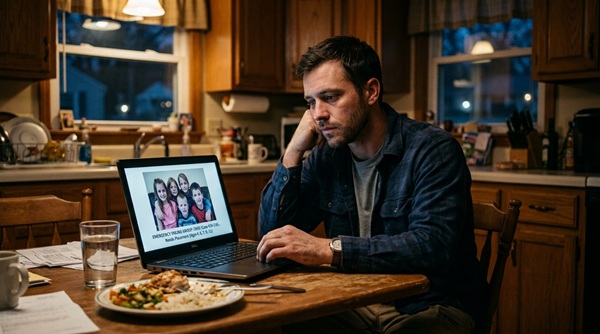
On the anniversary of the day the children came to live with me, I made a cake.
Nothing fancy.
Just chocolate cake.
I had learned the recipe because it was the only dessert everyone could agree on.
With five children, getting everyone to agree on anything is an achievement.
We sat around the table.
Five children.
One dad.
One cake.
I told them:
“A year ago today, our family started.”
Marcus looked at me.
“You did a good thing.”
He said it like a fact.
Amara nodded.
“A really good thing.”
Joel was more interested in the cake.
Destiny wanted another piece.
Nina was sitting at the table looking around at everyone.
I looked at them.
I thought about the man I had been before the photograph.
Twenty-nine.
Single.
Twenty-two thousand dollars saved.
A small house.
A plan to buy land someday.
I no longer had the savings.
I didn’t have the larger property.
I didn’t have the life I’d originally imagined.
But I had this.
This table.
This noise.
This chaos.
These five children.
The boy who no longer had to be the father.
The girl who filled pages with drawings of our house.
The little boy who talked endlessly about trucks.
The toddler who wore too many headbands.
The youngest girl who had once been afraid of everything and now called me Daddy.
I had seen a photograph.
I had made a phone call.
I had taken a risk.
People had told me it was impossible.
It wasn’t impossible.
It was difficult.
There is a difference.
It was exhausting.
It was expensive.
There were nights when I wondered whether I had made a terrible mistake.
There were mornings when everyone was crying and I was late for work and breakfast was on the floor and someone couldn’t find a shoe.
There were appointments.
School meetings.
Doctor visits.
Arguments.
Nightmares.
Bad days.
Very bad days.
And then there were the good days.
A child laughing.
A drawing on the refrigerator.
A birthday.
A sleepover.
A little voice saying “Daddy” for the first time.
A seven-year-old finally sleeping through the night without checking whether his siblings were okay.
Those moments made everything else worth it.
The courtroom was important.
The judge’s decision changed their lives.
But the courtroom wasn’t the real story.
The real story was every morning afterward.
The real story was getting five children ready for school.
The real story was learning who they were.
The real story was teaching Marcus that he was allowed to be a child.
The real story was learning that love isn’t one dramatic decision.
It’s a thousand ordinary decisions made again and again.
You show up.
You stay.
You listen.
You make breakfast.
You apologize when you get something wrong.
You try again tomorrow.
That’s what family became for us.
Not a perfect house.
Not a perfect parent.
Not a perfect story.
Just six people learning how to belong to one another.
And sometimes I still think about that photograph.
Five children sitting on a plastic bench.
Holding onto each other because they were afraid that letting go meant losing one another forever.
They didn’t know me then.
I didn’t know them.
I couldn’t promise them that everything would be easy.
I couldn’t promise them that I would never make mistakes.
All I could promise was that they wouldn’t have to face everything alone.
And that’s the promise I keep every day.
Marcus is learning how to be eight.
Amara is still drawing.
Joel still talks too much.
Destiny still wears more headbands than anyone needs.
Nina still wants to be carried when she’s tired.
And I am still learning how to be their father.
We’re not finished.
We probably never will be.
Families aren’t finished stories.
They’re ongoing ones.
Every day adds another page.
Another ordinary morning.
Another difficult night.
Another birthday.
Another drawing.
Another conversation.
Another chance to get something right.
When I think about the money I spent, I don’t think about the land I didn’t buy.
When I think about the workshop, I don’t think about the space I lost.
When I think about the life I thought I wanted, I don’t feel like I gave it away.
I think I finally found out what that life was supposed to be.
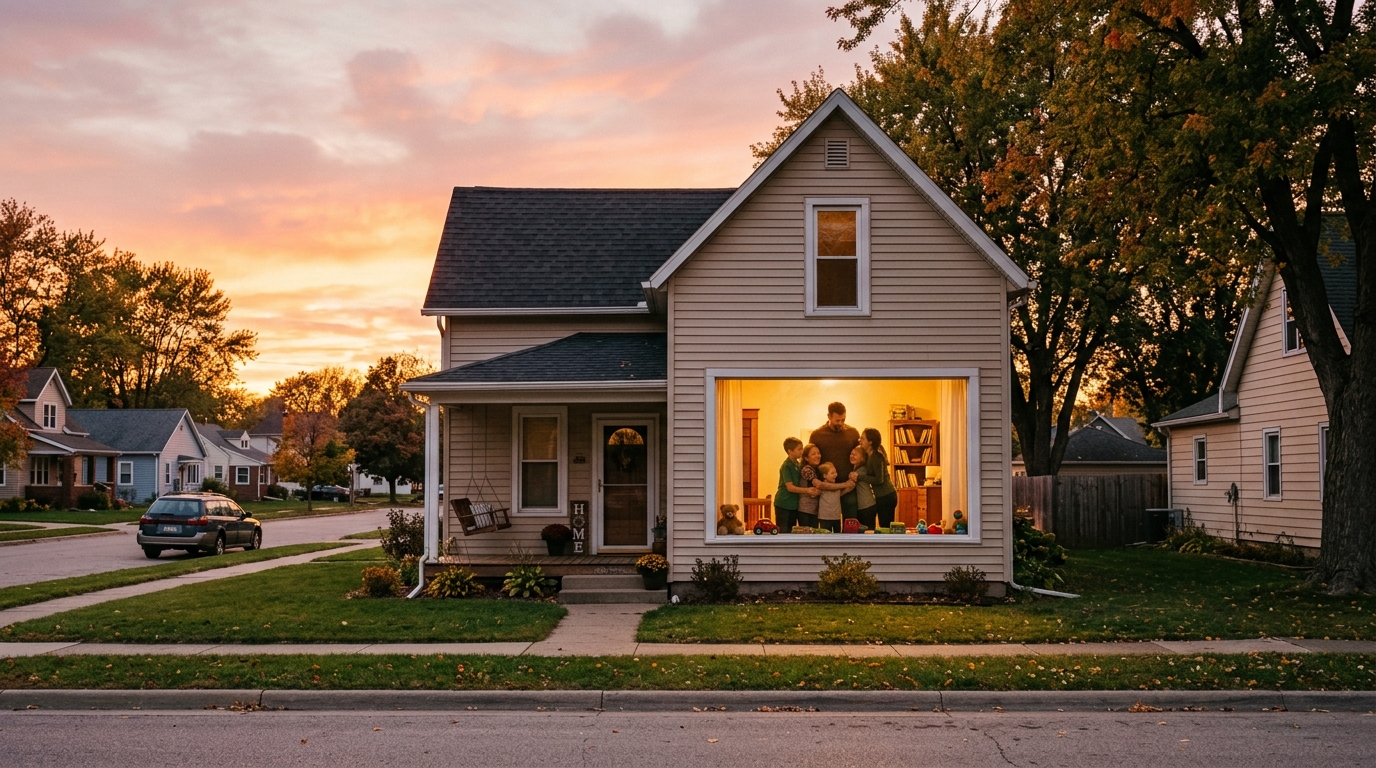
A home isn’t defined by how many rooms it has.
It’s defined by who feels safe inside it.
And that workshop?
Those bunk beds?
They became the most important thing I ever built.
Not because the wood was perfect.
Not because the room was beautiful.
Because five children walked through that door and slowly learned that they weren’t going to be separated anymore.
They were home.
And so was I.
That’s the whole story.
Or maybe it isn’t.
Because tomorrow morning, someone will wake me up too early.
Someone will lose a shoe.
Someone will argue over breakfast.
Someone will ask for pancakes.
Someone will need help with homework.
Someone will probably wear a ridiculous number of headbands.
And I’ll get up.
I’ll make breakfast.
I’ll find the missing shoe.
I’ll listen.
I’ll drive them to school.
I’ll come home.
And tomorrow, I’ll do it all again.
That’s what families do.
They keep showing up.
They keep choosing each other.
They keep going.
And sometimes the most important thing you can give a child isn’t a perfect life.
It’s simply the certainty that when they wake up tomorrow morning…
you’ll still be there.
❤️
Related Posts
-
 A MAN QUICKLY REGRETS THE NIGHT HE SPENT WITH A BEAUTIFUL GIRL
-
 Keith Urban and Carrie Underwood’s Duet of ‘Stop Draggin’ My Heart Around’ Stole the Show During the American Idol Finale!
-
 Millionaire Shocked to Find His Daughter and Grandchildren Homeless for Years — A Heart-Wrenching Tale
-
 She Tried to Stick Me With a $150 Lobster on Our First Date But One Detail Gave Her Away
About The Author

John Simmon
John Simmon is a music journalist and entertainment writer with a passion for country music culture, artist stories, and the moments that happen off the stage. He has been following the country music scene for over a decade, covering everything from chart-breaking newcomers to the legends who shaped the genre. John believes the best stories in country music aren't always found in the music, they're found in the lives behind it.
