They Laughed at the Woman in 22C… Until the Sky Saluted Her
Greg Whitmore didn’t bother lowering his voice when he said it. “This airline really lowered its standards. Anybody can get on now.” He said it like a man who had spent most of his life believing his opinion improved the room, and like most people of that kind, he expected agreement more than silence. A few nearby passengers laughed, others glanced over with mild curiosity, and just like that, attention shifted toward seat 22C.
The woman by the window looked like someone people decide things about instantly. She wore a faded gray hoodie, worn jeans, and scuffed sneakers that had clearly seen years of use. Her dark hair was tied back without care, and her head rested lightly against the glass as if she had been too tired to hold it up any longer. A canvas tote bag sat tightly in her lap, her hand wrapped around it like it held something important. In a cabin full of pressed suits, polished shoes, and quiet displays of success, she stood out for all the wrong reasons—or at least, that’s what everyone assumed.
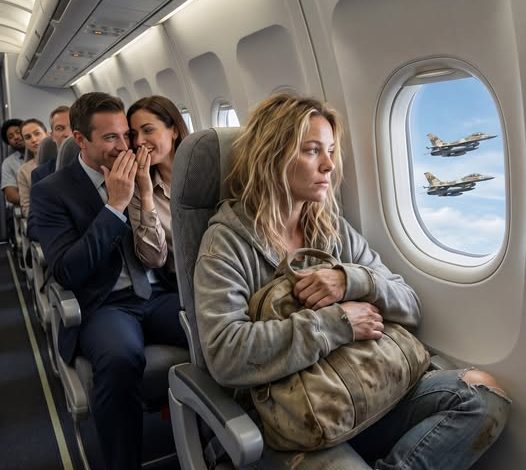
The comments came easily after that. A quiet remark here, a smirk there, a whisper just loud enough to be heard. Someone joked she must have taken the wrong gate. Another suggested she’d spent her last savings on a cheap ticket. Across the aisle, a woman angled her phone just right, capturing the hoodie, the bag, the stillness—turning a stranger into content for people who would never meet her. No one stopped it. No one questioned it. The woman in 22C, for her part, didn’t react. She didn’t defend herself, didn’t open her eyes, didn’t shift uncomfortably. She remained still in a way that wasn’t weak, but deliberate, as if she had learned long ago that not every moment deserved her energy.
Then the tone of the flight changed.
The captain’s voice came over the speaker, calm at first, then subtly strained. He mentioned a routing adjustment, an unexpected signal, and asked everyone to remain seated. It was enough to interrupt the rhythm of the cabin. Conversations paused. Phones lifted. The invisible wall between strangers dissolved just enough for shared uncertainty to creep in. Moments later, a sound cut through the aircraft—louder, sharper, unmistakably close. Heads turned toward the windows almost in unison.
Two fighter jets had appeared, one on each side of the plane.
They weren’t distant shapes in the sky. They were close—close enough to see the precision of their movement, the discipline in their formation, the silent message in their presence. The effect on the cabin was immediate and absolute. The earlier laughter vanished. The smug expressions faded. Fear, quiet and uninvited, took its place. People leaned forward, gripping armrests, searching for explanations that weren’t coming fast enough.
In seat 22C, the woman opened her eyes.
She didn’t panic. She didn’t look confused. She simply looked… aware. Her gaze moved to the window, lingered there for a second, then dropped briefly to her hands before returning outside. It was a small sequence of movements, but it carried a kind of certainty that didn’t belong to the rest of the room. Then, in a voice so calm it almost went unnoticed, she said, “They’re here for me.”
At first, it sounded absurd.
A man nearby laughed under his breath, dismissing it instantly. But others had heard it now, and something about the way she said it—without drama, without hesitation—made it linger longer than it should have. A flight attendant stepped in, firm and slightly irritated, asking her not to make statements that could alarm passengers. She didn’t argue. She didn’t explain. She simply stood up.
That’s when the room changed again.
There was nothing dramatic in the way she moved, no attempt to draw attention, but attention followed her anyway. She stepped into the aisle and walked toward the front with quiet confidence, the kind that doesn’t ask permission because it doesn’t expect to be denied. The flight attendant tried to stop her, but hesitated just long enough for her to pass. Something in her presence made confrontation feel misplaced.
When she reached the communication panel, she picked up the handset with the ease of someone who had done it before—many times, under far worse circumstances. The cabin fell into complete silence as she pressed the transmit button.
“This is Night Viper Two-Two,” she said. “Requesting acknowledgment.”
For a moment, there was nothing.
Then came the response.
“Night Viper Two-Two… we copy. Welcome home, ma’am.”
Outside the windows, both fighter jets tilted their wings in perfect, synchronized acknowledgment.
It wasn’t just a gesture. It was recognition.
And in that instant, everything shifted.
The same people who had laughed minutes earlier now sat frozen, unable to reconcile what they were seeing with what they thought they knew. The woman in the hoodie—the one they had dismissed, mocked, and reduced to a joke—was being honored by the sky itself. Not for appearance. Not for status. But for something far beyond either.
When she returned to her seat, she didn’t explain herself. She didn’t demand apologies. She didn’t correct anyone. She simply sat back down, her hand resting again on the worn tote bag, as if nothing about her had changed—because, in truth, nothing had. The only thing that had changed was how everyone else saw her.
Eventually, someone found the courage to ask the question that had been building in the silence.
“Why didn’t you say who you were?”
She looked up, her expression calm but firm, and answered in a way no one on that plane would ever forget.
“I don’t owe strangers a résumé before they decide to behave.”
No one spoke after that.
Because deep down, they understood.
This was never about who she was.
It was about who they chose to be—before they knew.
And that realization stayed with them long after the plane landed.
Related Posts
-
 He Won The Lottery… But The Real Prize Was Finally Walking Away
-
Country Singer Rory Feek, 59, Marries Again in a Stunning Cliffside Wedding 8 Years After Losing His First Wife
-
(VIDEO) When Comedians Blank Out: Hilarious Improv at Its Best!
-
The Unexpected Birthday Invitation: Unveiling a Heartfelt Journey Through My Son’s Celebration, A Story That Moved Me to Tears


About The Author

John Simmon
John Simmon is a music journalist and entertainment writer with a passion for country music culture, artist stories, and the moments that happen off the stage. He has been following the country music scene for over a decade, covering everything from chart-breaking newcomers to the legends who shaped the genre. John believes the best stories in country music aren't always found in the music, they're found in the lives behind it.
